The Baby / Human Project: An Experimental Way To Look At Personal Development

Ever since I was a child I have had this instinctive urge for expansion and growth. To me, the function and duty of a quality human being is the sincere and honest development of one’s potential.  ~ Bruce Lee
baby_rachelle


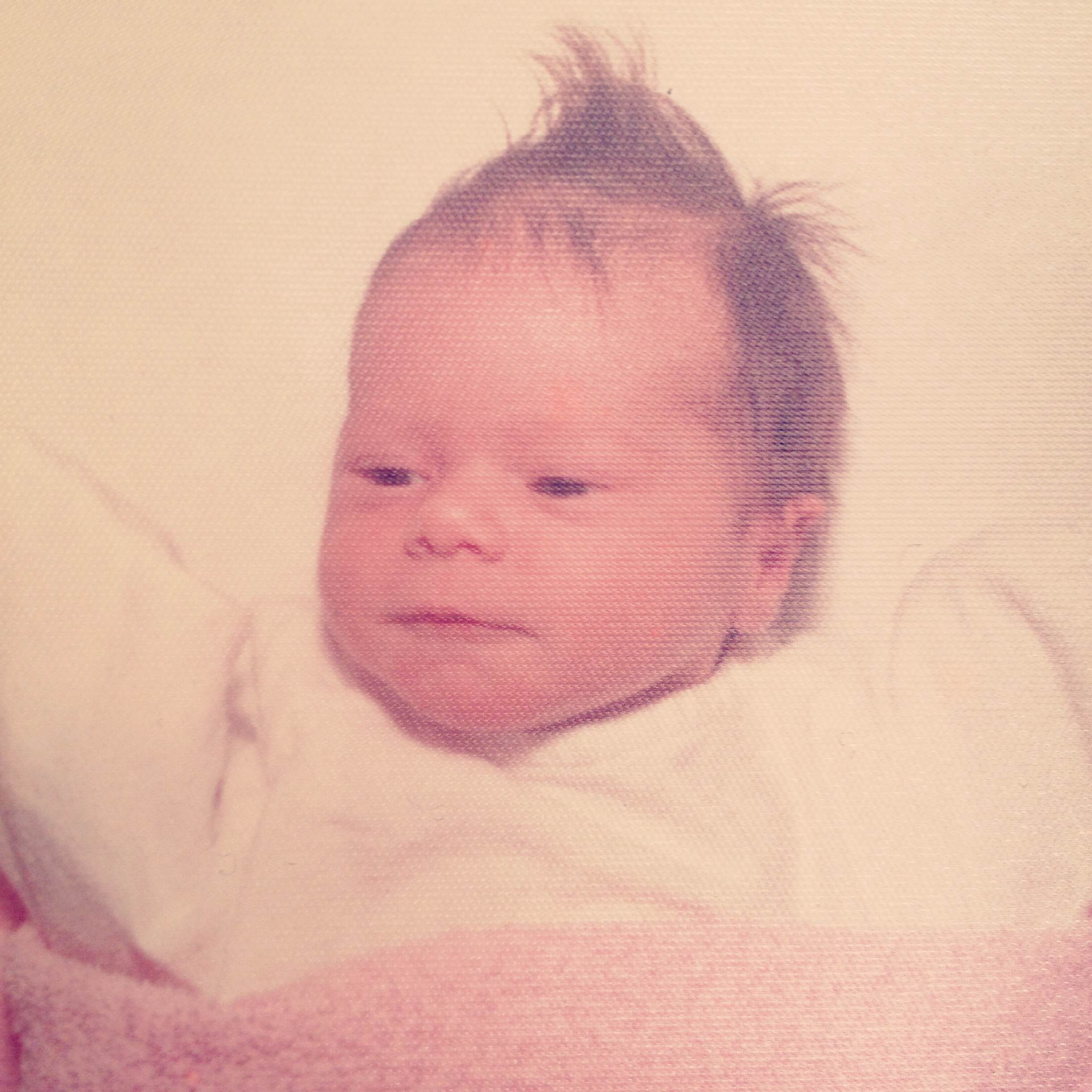
This is a picture of me, taken shortly after being born. As you can see, I was born with quite a lot of hair!

I’ve been thinking a lot about why people choose to have kids, or conversely, why some may choose not to have kids. I’m in my mid-thirties and I’m still not entirely certain as to whether or not I’ll ever choose to bring another life into this world. Currently I’m leaning towards remaining child-free. However, living in a world that largely revolves around the cultivation of meaning and purpose from a lifetime investment in one’s creation of or participation in a nuclear family unit, it’s sometimes hard to ignore the possibility of such a path.

If I ever decide to have a kid, I want my decision to be made with certainty and enthusiasm — a definitive, “Hell YES!”  vs. a wishy-washy, “Welll…. I’m going on 40 and still haven’t procreated… so maayybe I should have a baby before it’s too late.” Or vs: “I better start a family so I’ll have someone to take care of me when I’m old.”

Thanks… but No Thanks!

Aren’t those kind of messed up reasons to have a kid? Think about it.

If one of your main reason to create a family is to ensure you’ll have someone to take care of you when you’re elderly, isn’t that essentially akin to birthing your child into an eventual form of expected and indentured servitude? Isn’t that a lot of expectation and obligation to put onto someone, especially before they’ve even been born?

Anyway, I digress… this article isn’t meant to be about my personal frustrations with societal norms and expectations when in comes to child and family rearing. Rather, this article is meant to serve as a reminder that each and every one of us started out as a baby.

We were all born.

We live.

And, eventually, we will die.

Each and every one of us.

This isn’t meant to sound depressing. In fact, it’s meant to be just the opposite.

Infinite Potential vs Expected Norms

A baby isn’t just a baby. A baby merely represents the early stages of a human’s entire lifetime which will be filled with lessons and learning, growth, goals, desires, failures, successes, and achievements. All stories have a beginning, middle, and end. Babies represent the beginning – i.e. the part of the (human) story that we tend to associate with the most potential, and therefore, the most hope.

Before you know it, a baby progresses to an infant, then toddler, pre-schooler, school-aged kiddo, pre-teen, teenager, high schooler, and eventually/hopefully… a high school graduate.

And then… adulthood! (Gasp!)

Of course, the list doesn’t stop there. After high school, many will choose to go on to college or university, and perhaps even continue on to obtain a Masters or a PhD. Some might choose to pursue a career via a stable job in a chosen and well-respected and established profession. Some might choose to marry. Some might choose to have a child or children of their own, perpetuating this cycle that seems pertinent to human growth and development.

The pattern tends to be, or so I have observed, that once we have gone through the common levels or major steps of education, we tend stop growing and learning. Not altogether, of course, as learning and growth are ongoing, intrinsic and inherent aspects of the human experience.

The above said, I’ve noticed that when we stop actively learning and pursuing knowledge, it generally seems the next step we humans tend towards is to “settle down” and become complacent in many ways in order to carve out the space and energy to start a family — to take personal participation in the cyclical pattern of human evolution and development that we have experienced up until now.

If, however, you’ve decided not to participate (or at least hold off participation) in the genetic procreation of the human species… then what?

Now What?

What am I supposed to do with my life?

What am I supposed to achieve? What should I aim to accomplish? And while we’re at it, What’s the purpose of meaning of life, anyway?

Those are pretty big questions… aren’t they?

I think one of the reasons many people choose to have kids – aside from social conditioning, tradition, and learned values – is because you might not be sure what else you’re supposed to do with your life. It’s sort of expected and taken for granted… isn’t it? And if and when you start to ask yourself these big questions, one of the easiest and simplest answers you come up with might be … to live and love. To have kids and perpetuate what we think of as family.

Tied into all this, I think that we may also naturally want to experience that amazing period of wonder and condensed growth all over again… but vicariously, through our offspring. I’d imagine there’s nothing that seems quite as miraculous as the growth and development of a baby into a fully grown, intelligent and conscious human being.

Furthermore, we can look at humanity as a whole as still being in its relative infancy. And of course, there’s the notion that the entirety of humanity is one big family. What is your deepest hope and desire for humanity to achieve and experience as a species as it continues to grow and develop?

Babies vs Grown Ups

The trouble with the term ‘grown up’ is that it implies there’s no growing left to do… you’re already all grown up!

What if we stopped thinking of ourselves as grown ups or adults once we actually become adults? What if we were to realize that, in a way, we’re still that same being that was a baby?

What if we put our focus on the fact that there are still soooo many ways for us to keep on learning and growing well beyond and into our adult years, even throughout our entire lives?

What if you take on the role of parent for yourself vs that of another being you created (or that created you), in part, from your own (or their own) DNA?

As a parent, caregiver, or guardian over another, you would naturally want and desire the very best for your child. You would want them to be happy. You would want them to learn and grow, to fulfill their potential to the very best of their abilities. You might even want them to attain some level of achievement, recognition, and success. We generally want for others what we want for ourselves, which is the very best.

Here’s a creative project I’d like to try. Maybe you’d like to try it too. I’m calling it…

The Baby / Human Project: A New Way To Look At Personal Development

The first step is to consciously and fully realize that you started off as a baby. Even though I’m a fully grown adult and have been for some while, I recognize that I’m still learning and growing — or at least have that potential.

The second step is to find a picture of yourself as a baby. The younger, the better. That’s why I’ve chosen my baby picture as a new born.

With the baby picture in hand, study it carefully. Look at the baby’s eyes, facial expression, and physical features. Can you tell that this is you? When I look at my baby picture I can easily recognize that this baby was/is, in fact, me. I can see certain facial characteristics that I still share with that baby. It’s amazing to think that that’s how I started out and that I still share some of the features as my new-born self. If you are doing this too, I encourage you to identify as much with that baby in the picture as possible.

The next step is sort of an opposite to the previous. Now imagine that the baby in the picture is not you at all. You can imagine that the baby in the picture is a baby that exists now in the present instead of a baby from the past. Imagine that baby has not grown up yet and is still full of so much potential. Imagine the wonders that baby might one day experience. Imagine that baby is actually your own child. You might even project your own hopes and dreams onto that child… what is it that you’ve always wanted to do yet never achieved?

…Isn’t that what many parents tend to do? Project their own hopes and dreams onto the future of their child? Whether projecting your hopes and dreams onto your children is something positive or negative is a whole other can of worms. But in any case, don’t worry about doing so in this situation, as projecting your hopes and dreams onto the baby in the photograph is perfectly fine and good!

What do you feel or observe as a result of following these steps? For myself, I observe that I tend to project a very strong, almost overwhelming and unconditional love for the baby in my photograph. I imagine this is what many parents might feel towards their own children. And, connected to this deep sense of love, I notice myself wishing and wanting all the best for that baby in the photograph — I want her to grow up to pursue her dreams, attain great success and achievement, and experience a life filled with love and happiness, all while treating herself with loving kindness absent from any harshness directed towards herself, in addition to compassion and patience for any of her so-called flaws.

The next step in this project or experiment is to re-associate that baby in the picture with your present-day self. See yourself as that baby, and perhaps even vice versa as well. But most importantly, carry that deep sense of unconditional love forward with you, such that you find yourself experiencing a very deep sense of caring and love for, ultimately, yourself. Carry that sense of hope and recognition of infinite potential forward with you to your present-day self. Really feel it and let yourself feel all warm, fuzzy, and excited about the future that lies in store for you.

It’s quite possible that following these steps may lead you to experience a deeper sense of unconditional love for yourself than you’ve ever experienced before.

Again… Now What?

You may be thinking… “Okay, Okay. I get it. I love myself. I see that, in a sense, I’m still a baby. I’m still learning and growing. I can still achieve my dreams if I want to. That’s all fine and good. But now what? What’s the overall point?”

Just like any other aspect of life, that’s really up to you.

As an extension and application of this project, what I’d like to recommend is a (minimum) 30-day trial of practicing the steps I described above.

A 30-Day Experimental Project

Each day, preferably sometime in the morning, take a moment to go through the steps of disassociating and then reassociating the baby in your picture with your present-day self. Feel that deep sense of love for that baby and then for yourself. Get excited at the profound potential for the future of that baby, and then also for yourself.

Then see where it takes you.

This new way of looking at, thinking of, and loving yourself might very well fuel you to thrust forward in making tremendous progress in your own hopes and dreams for yourself and your own personal development.

I’m going to take on this 30-day trial for myself. I’m not quite sure what kind of progress I’ll make, but I have a feeling that I’ll make exponential progress towards my various personal projects and goals compared to the progress I have made over the past year, or even, years.

I guess time will tell!

I shall report back after the next 30-days and share my progress and findings.

If you also decide to take part in this baby/human experimental project, please feel free to share your personal results and findings as well! You can share by leaving a comment.

Consult not your fears but your hopes and your dreams. Think not about your frustrations, but about your unfulfilled potential. Concern yourself not with what you tried and failed in, but with what it is still possible for you to do.  ~ Pope John XXIII

The will to win, the desire to succeed, the urge to reach your full potential… these are the keys that will unlock the door to personal excellence.  ~ Confucius
How Facebook Killed My Creativity

Facebook-Dislike-Thumb-DownEarlier this week I deactivated my Facebook account.

Recently, Steve decided to dump all social media services. Before he did so, the discussions we shared about the possibility of deleting one’s Facebook account resonated with me quite deeply, and I cannot deny that I share a similar desire to dump Facebook (and other forms of social media) as well.

I realize that deactivating my account is not the same as deleting it completely. Ideally, I’d like to close my account all together. I have a few conversations that are still going on on there that I haven’t finished up, nor have I gone ahead and told people of plans to close my Facebook account. As such, I think I may end up reactivating it sometime during the latter half of this month to inform people of my intention, so that we’ll have an opportunity to trade communication and contact info should we desire to keep in touch outside of Facebook. Also, I may use it a bit to promote my play at the upcoming  Edmonton International Fringe Theatre Festival that I’ll be performing next month. But afterwards? I’m seriously considering nuking it for good.

I still have a Twitter account, not to mention accounts with Instagram and Google+ (which I rarely use). And although I find these services to be less addictive than Facebook, I am considering deleting my accounts with these services as well.

That said, I do have some qualms about going that route. There’s part of me that fears being left out or being forgotten if I were to completely opt out of Facebook, Twitter, social media and the like. But if my primary reason for remaining in servitude to these various social media platforms was based in fear, then all the better reason to completely release them and let them go.

Google Me, Twitter Me, Instagram Me, Facebook Me

These past few days or so without Facebook have definitely got the neurons in my brain working a bit differently. It’s kind of disturbingly fascinating how so many people, myself included, have come to draw parallels between their ego and identity and that of their online and social media presence.

With a Facebook profile, you can so easily and readily define yourself to the world: I live here. I work there. I have this many friends. I’m in a relationship with so-and-so. These are my pictures. This is what I look like. This is what I’m thinking or feeling. This is what I did today. This is what I plan to do tomorrow. I like this status. I like that comment. And this is what I have to say about that. I listen to this music, watch these shows and films, and read those books. These are my favorite quotes. This is what I eat. Here’s my cat/dog/rabbit/turtle/hamster/gerbil/fish/bird/baby/kid. And, oh, in case you haven’t figured it out…

Take the summation of all this data, and you are presented with:

This is who I am. This is me.

Yet, we are so much more than the collection of our likes and dislikes as summated into mere 1s and 0s in some database, which is then represented and perceived by someone’s visual cortex via some digital device’s pixelated display. …Aren’t we?

Social Media, Creative Impetus, and Procrastination

Recently, I’ve been connecting some dots and have come to realize that the nature of the immediacy of social media has been a huge factor in thwarting my creative impetus for the past half decade or more.

How so? Well, it would seem that my innate desire for creative self-expression can (and has) often be calmed and soothed by simply sharing something on Facebook, Instagram, or Twitter, etc.. Maybe it’s a link to an article that I resonate with, an image that I find to be inspiring, or a status update about my thoughts and feelings.

Obviously, there’s nothing inherently wrong with doing any of these things. After all, passing on an inspiring image via social media might very well help to create positive ripples in the world. Right? …Maybe. But what’s troubling is the fact that doing so — along with other social media inspired actions — has been supplanting my innate desire to create and work on my own creative projects that exist completely outside of the sphere of social media. …Projects that are much, much, much larger and longer in form than what might be conveyed in any simple share, tweet, or status update.

This act of continually streaming one’s status, thoughts, feelings, updates, and so on, in such small yet immediately publishable and sharable outputs — each immediately whole and complete — has the potentially to continually reset one’s creative impulse back to zero, or at least near to it, such that taking on larger creative endeavors (like writing a play or screenplay) feels so vastly and grossly overwhelming in comparison to the exceedingly quick composition and release of a social media update. At least, such is the case for me. And who knows… if you’re a creative or artsy individual who’s been struggling with productivity, procrastination, and creative output, then perhaps such is the case for you, too.

Whether it be by design or happenstance, these social media inspired actions — the immediacy of publishing tiny bursts of easily digestible material, sharing something that one resonates with, posting a status update on thoughts and feelings, etc. — give us a false sense or impression of creative release, productivity, and accomplishment. We might feel like we’ve added to the state of the world, having shared something important, done our part, or whatever.

…But in reality, is the world truly any better off for having shared your two cents in some conversational debate posted on some random Facebook wall?

Reclaiming My Creative Impulse

Having come to the above realization, I’m beginning the process of trying to reclaim my creative impulse / impetus from its grown attachment to social media. It’s almost as if the two had some sort of symbiotic or perhaps even parasitic relationship with each other. But the time to cut their independence upon each other is nigh.

So far, I’ve been finding that cutting myself off from Facebook definitely helps. I suspect that the longer I am disconnected from Facebook, as though I were previously some Borg connected to the greater collective hive mind, the stronger and more resilient my creative impulse will grow. And I suspect that my creative spark will come to crackle and glow into a high-powered lightening bolt should I let go of social media in all its forms.

Without having Facebook and other forms of social media as an easy outlet for creative self-expression, I have no doubt that the force of my creative impulse will soon outgrow the pull of stagnation, procrastination, and the maintenance of the status quo. And given that I haven’t written a new blog entry in over half a year, this blog post itself is proof.

Responding to vs Creating My Reality

Something else I’ve been noticing is how various social media — Facebook and Twitter especially —  seem to produce and strengthen my need or desire to respond to stimuli outside of myself, vs honing in on my individual creative impulses and desires rooted from within in order to deliberately and consciously create my reality.

I believe that a huge component and proponent of procrastination (and why it exists) is based upon this learned need; a need to respond to external stimuli before we allow or give ourselves the time, space, and permission to tune in and respond to our inner impulse to identify and cultivate our own desires.

From a young age, so many of us are trained to believe that living, dreaming, and creating for ourselves is inherently selfish, and therefore should only be followed and fulfilled if and when we’ve met the expectations and needs of forces outside of ourselves:

You can go outside to play after you’ve finished cleaning your room and after you’ve done your homework. You can work on your passion only after you’ve worked at your soul-sucking job and have paid off all your debt. (Although, with no soul left, your will to do so has probably left you, too.) You can work on your screenplay after you’ve responded to all your email and checked your social media.

The problem with simply “checking” social media, however, is that it’s a never-ending task with no concrete end or completion in sight. Because it’s constantly being updated with new tweets, shares, updates, and more, there’s no clear end to the act of checking it, ever. We get sucked into some kind of perpetual self-propagating loop that has no end. And, as a result, we might even end up feeling as though we can’t yet give ourselves our full permission to work on a passion or creative project, because we’re still responding to that trained need to only allow ourselves such a luxury until after we’ve responded to and met all the needs of the others in our lives… even if they might only exist in our lives in some sort of virtual way.

My Creative Revolution

I believe I am on my way to starting my own personal creative revolution. It will bring me back to a time before social media usage; a time similar to when I was a young child or even teenager, ripe with ideas and creativity.

Instead of wasting time in the endless loop of social media (because it didn’t even exist back then), I’d instead read stimulating books — both fiction and non-fiction alike — and  write short stories, paint, draw, learn or compose music, or maybe even make up a play.

I’d contemplate the nature of the universe. I’d teach myself about atoms, insects, planets, stars, light, particle-wave duality, fusion and fission.

This week I started re-reading A Brief History of Time — a book I initially started about 20 years ago, back when I was 14 or 15 years old, but then never finished due to being so busy with school and then later a relationship.

I simply love reading, contemplating, and learning about the nature of reality, the universe and existence itself. I think it must be my most favorite topic in… well… the whole entire universe!

It is my hope that my creative revolution will bring me back into alignment as a thinker and a seeker — one who seeks out creative expression in response to life’s greatest questions: Who am I? Why am I here? What is the meaning and purpose of life?

I’ve been asking myself these questions for a long time, and yet, in the absence of the distraction of Facebook, it seems as though the drive to ponder, address, and live in accordance to seeking answers to such questions feels even stronger and amplified than before. And it’s a wonderful feeling.

But why is this? My theory is that Facebook tends to lull us into some kind of false sense of identity (and perhaps even a false sense of security) in regards to such questions, which ultimately dampens and mutes our natural desire for greater questioning and creative self-expression. And thus, the need for a creative revolution has arisen.

Although the act of writing and publishing a blog post such as this one is relatively immediate in comparison to longer creative works such as writing a book, or a play, or a screenplay, or making a movie, etc., it sure is a hell of a lot longer and requires a lot more commitment than the immediacy of publishing thoughts via a status update on Facebook, or a tweet on Twitter.

I’d like to recommit and reinvest in my creativity. I believe giving up Facebook, and greatly restricting — if not dumping all together — other forms of social media will play a surprisingly large part.

Without having Facebook as an easy creative outlet, my desire for creative expression will naturally rise. I’ll resort to longer-lasting creative outlets, like writing a blog post, working on a play or screenplay, or working on my career.  With time and commitment, I will rebuild and strengthen my creative voice, my creative resilience, and my creative resolve.

Have you had difficulty committing to your creative endeavors? How much time do you spend on Facebook a day?

Let’s give up Facebook and social media together.

Here’s one option to explore without fully deleting your Facebook account: 99 Days of Freedom. I’m thinking of trying it out, to help spread the word and the movement.

Will you join me?